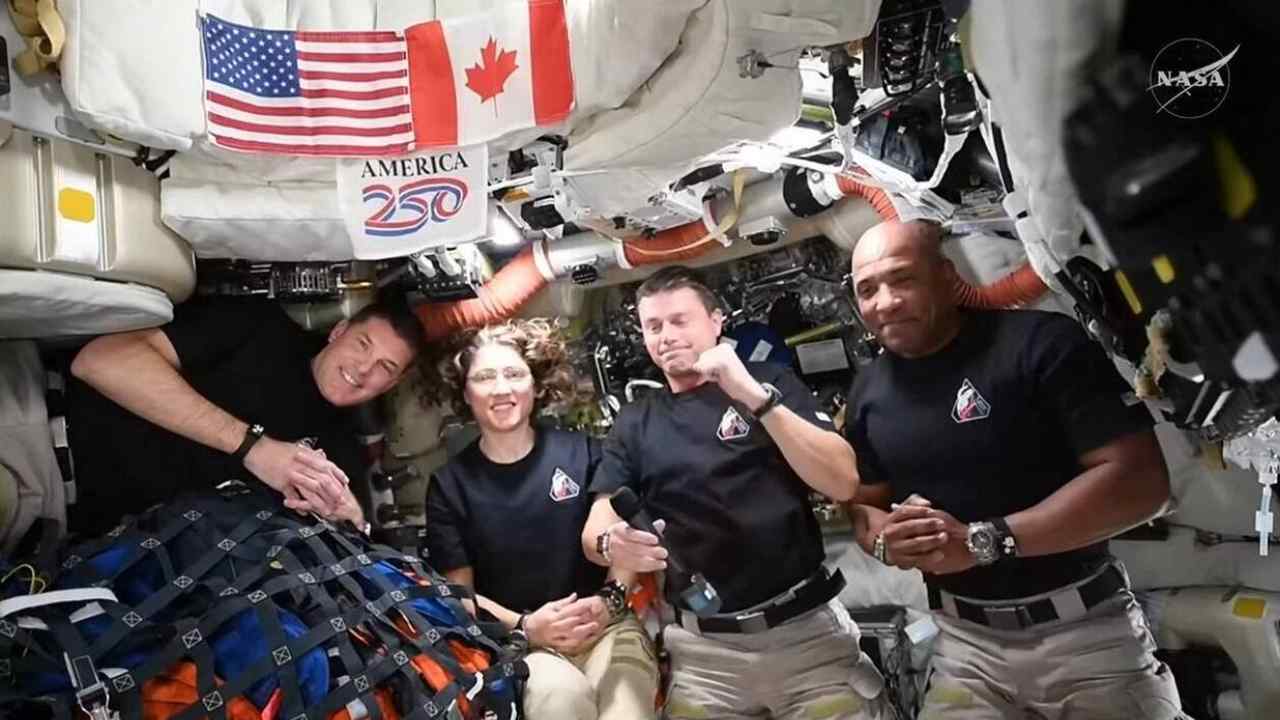
Little-known lunar craters, a sunset and sunrise and a solar eclipse: after a flyby of the Moon full of highlights, the four Artemis astronauts returned to Earth.
"We will come back," said Christina Koch, a veteran explorer who goes down in the history books as the first woman to fly over the Moon, adding: "we will be sources of inspiration, but we will always choose Earth."
The American president called them to warmly congratulate them.
“Today you made history and you made all of America really proud, incredibly proud,” he said to the Americans Reid Wiseman, Victor Glover and Christina Koch as well as the Canadian Jeremy Hansen, who not only have just completed the first flight around the Moon since 1972, but have gone further into space than any human before them, more than 406,000 km from Earth.
Glued to the portholes for almost seven hours, they benefited from a unique perspective to observe the Moon, higher (6,500 km) than the more crushed view of their Apollo predecessors at around a hundred km.
Discovering the lunar landscapes with wonder, they provided countless descriptions of the reliefs or even the brown and greenish shadows of the lunar craters and soil.
“We see a very beautiful double crater. It looks like a snowman,” depicted pilot Victor Glover, who became the first black astronaut to participate in a lunar mission. "It's really hard to describe. It's incredible."
The astronauts observed regions of the far side which "had never appeared illuminated during the Apollo missions", confided to AFP, at the end of this historic day, Jenni Gibbons, the Canadian astronaut who on Monday ensured all communications with the crew from the NASA control room in Houston.
“Some of the features that Artemis II observed and described today, no human eye had ever seen,” she explained. “This is the first time that the most sensitive cameras in the world, namely human eyes, have been able to observe them.”
- Earthrise -
Their return will take place on Friday off the coast of California, where their Orion capsule will land, slowed by parachutes.
NASA insists on the scientific importance of the mission. The flyby was broadcast live and in very high definition on several platforms such as Netflix and YouTube, thanks to GoPro cameras installed outside the vessel.
During the flyby, the astronauts passed behind the Moon for 40 minutes, which cut off communications, as in the days of Apollo.
They witnessed this spectacle observed by only a few humans in history: a setting and rising of the Earth. As well as an eclipse where the Moon blocked the Sun, worthy of “science fiction”, exclaimed Victor Glover.
They notably intended to immortalize the Earth rising, like
Enjoying Mauritius News in English?
You've used 4 of your 5 free articles today. Subscribe for unlimited access plus a daily newsletter.