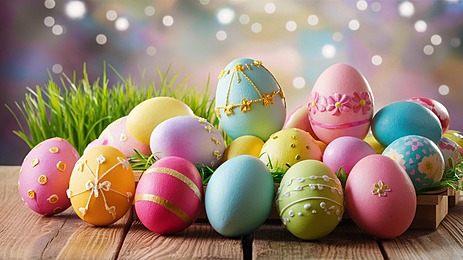
Every year, the same decor is set up: gardens transformed into egg hunting grounds, lively family tables, scents of chocolate and generous dishes. Easter today seems obvious, almost light. And yet, behind these familiar gestures lies a celebration of astonishing depth, shaped by centuries of intertwined history, beliefs and symbols.
For Christians, Easter is the most important holiday on the calendar. It celebrates the resurrection of Jesus Christ, three days after his crucifixion. This founding moment is not just a memory: it embodies the victory of life over death, the promise of possible renewal for humanity.
At the end of Holy Week, marked by contemplation and meditation, Easter Sunday opens a time of light. In the churches, the faithful celebrate this rebirth in an atmosphere that is both solemn and joyful.
But Easter is not just about a fixed calendar. Since the Council of Nicaea, its date has been determined according to a precise calculation: the first Sunday following the full moon after the spring equinox.
This link with the lunar and solar cycles is not trivial. It reminds us that this festival takes place in an even older time, that of the seasons and the return of light after winter. Long before Christianity, spring was already celebrated as a victory of life over darkness.
The central symbol of Easter, the egg crosses civilizations.
In Antiquity, in Egypt as in Persia, it represented the universe in the making, an enclosed life ready to hatch. Later, in the Middle Ages, the Church prohibited its consumption during Lent. The eggs were then preserved, then decorated and offered at Easter time, marking the end of the fast.
From this heritage was born a still living tradition, transformed today by chocolate but faithful to its original meaning: that of a rebirth.
More unexpected, the Easter bunny owes nothing to religious texts. It finds its origin in the pagan traditions of Northern Europe, where the hare was associated with the goddess of spring, Ostara.
Fertility animal par excellence, it symbolized abundance and renewal. With European migrations, particularly German ones, this figure spread until it became one of the most popular emblems of the festival.
The Easter meal is also loaded with symbols. The lamb, often in the center of the table, refers both to Passover, which celebrates the liberation of the Hebrew people, and to the sacrifice of Christ in the Christian tradition.
In both cases, it is a passage: from slavery to freedom, from death to life. Easter thus carries, beyond beliefs, a universal idea of transformation.
Today, the party took on lighter accents
Enjoying Mauritius News in English?
You've used 4 of your 5 free articles today. Subscribe for unlimited access plus a daily newsletter.



