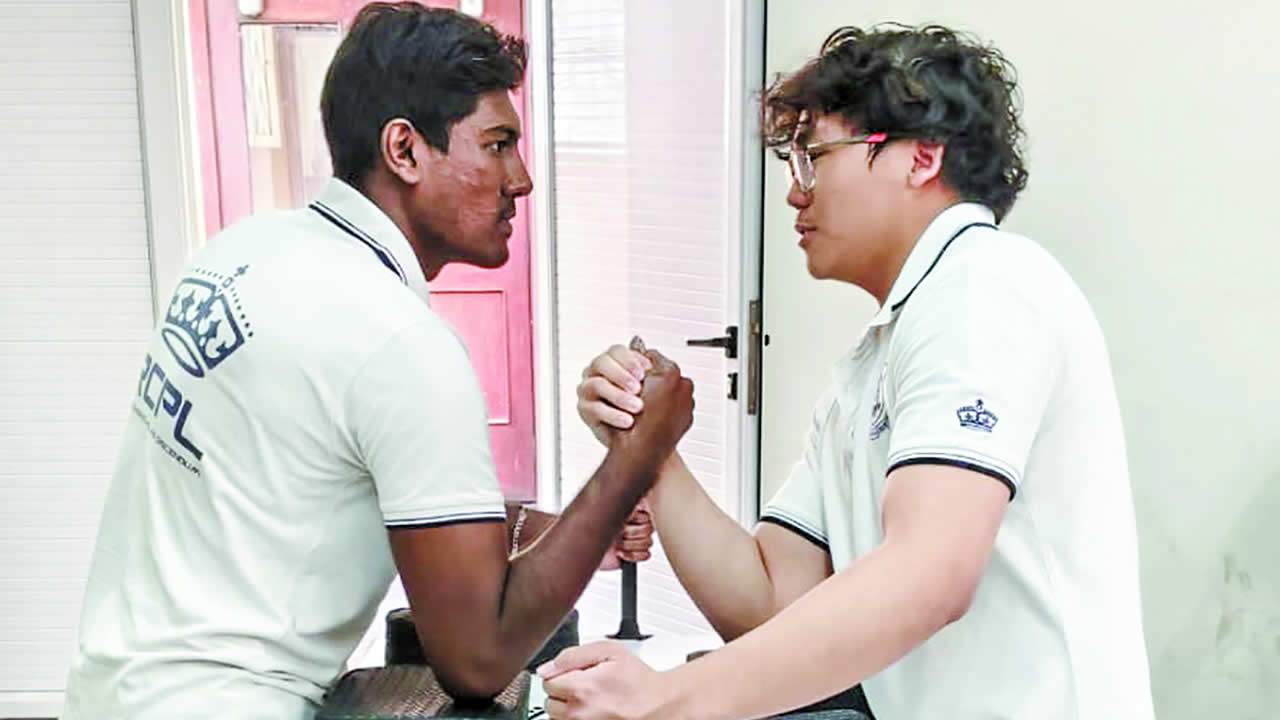
At 17, a student at the Royal College of Port-Louis (RCPL), Justin Yong created from scratch the first school arm wrestling club in Mauritius. Not by chance, by stubbornness. And by an ability to bring others together that we don’t necessarily expect at this age.
It all starts with an image from Canada. His brother, there, practices arm wrestling in a structured framework: regular training, organized competitions, a community of practitioners who meet around regulatory tables. The discipline is recognized, supervised and taken seriously. Justin watches from Maurice, and something settles inside him. Not from desire. Determination.
In schools, arm wrestling is at best an improvisation between friends in a playground. No club, no supervision, no regulatory table. Justin joins the RCPL in 2024 and sees this void not as an obstacle, but as a blank page. “My goal was not just to start a club at my college, but to lay the foundations for other schools to follow. »
First of all, a clarification. Arm wrestling is not a contest of brute force between two guys eyeing each other. It is a discipline in its own right, demanding, close in spirit to a martial art. There are codified positions, precise angles, careful placement of the wrist, the shoulder, the trunk. Opposing strategies that can be read in a fraction of a second: attack from the start to surprise, or absorb the opposing pressure and let the other tire out. Force upwards to destabilize, or pull towards you to break your balance.
And above all, self-control that muscles alone do not provide: remaining lucid when your arms are burning, managing the effort over time, not giving in to panic in the decisive seconds. “It’s not just about brute force. There is technique, discipline and control. Respect for your opponent, self-control, effort management... so many values that this sport naturally transmits. »
In a school context, these dimensions take on particular relevance. They complement what the class teaches: rigor, concentration, the ability to cope and bounce back. This is precisely what convinces Justin, long before he thinks of creating anything: not victory for victory's sake, but what regular practice builds in those who dedicate themselves to it.
What Justin quickly discovers is that starting a club is less about the sport and more about the people. We must convince management – explain, reassure, demonstrate that the project is serious and that student safety is at the heart of the system. It is necessary to define training rules, find competent supervision, and structure an activity which has no precedent in the Mauritian school environment. Above all, we must bring people together around a common idea, and do it with sufficient confidence.
Enjoying Mauritius News in English?
You've used 2 of your 5 free articles today. Subscribe for unlimited access plus a daily newsletter.


![[Info Soirée] : "He wanted to burn the shop there"](/media/article_images/ad7f1cd9c711.jpg)