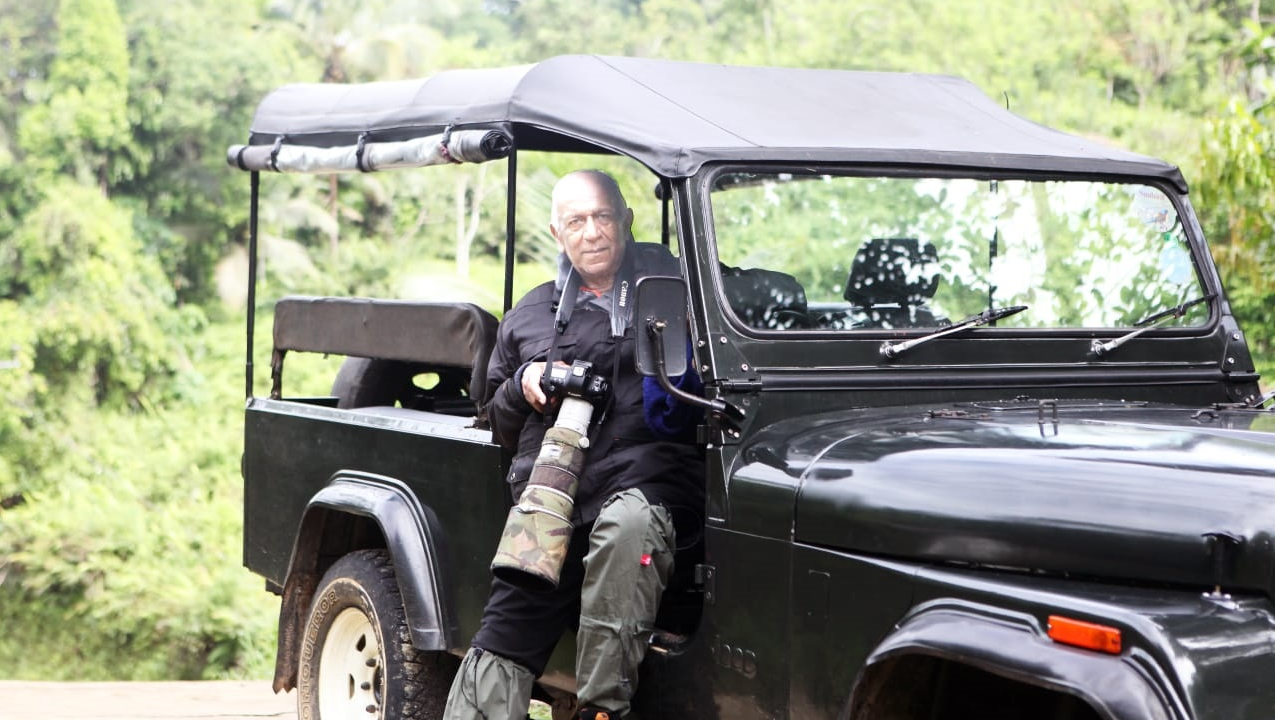
Former VIP and aerial photographer within the Royal Air Force, ornithologist Narainsamy Ramen immortalizes birds of the Indian Ocean in their natural habitats. His work “Birds of the Indian Ocean” unites art and advocacy, making him a committed voice for conservation and the fragile beauty of our oceans.
Narainsamy Ramen, “Birds of the Indian Ocean”, what exactly is it? “Birds of the Indian Ocean” is a monumental work in two volumes (520 pages for the first, 548 for the second), bilingual English-French, published in December 2021. The work lists more than 1,000 species observed on 1,500 islands belonging to 12 nations in the Indian Ocean. Each photograph is the result of my expeditions across 23 islands in the region, with the exception of a few shots taken by colleagues, always duly credited.
What is the geographical coverage of the work? It extends from Madagascar to the Comoros, from the Mascarenes (Mauritius, Reunion Island, Rodrigues) to the Seychelles, via the Scattered Islands, Pemba, Socotra, Sri Lanka, the Chagos Archipelago, the Maldives, Lakshadweep, Christmas Island, the Cocos (Keeling) and the Andaman & Nicobar Islands.
What were the main challenges encountered for this expedition? Some stages were particularly difficult, such as Madagascar, much larger and more complex than expected, or our Mauritian islets such as Round Island, Gabriel Island or Ile aux Aigrettes where the birds were introduced mainly as part of supervised visits.
What does the book include? This work brings together the complete account of my travels and observations, accompanied by photographs of endemic, rare, migratory and extinct species. It also features subspecies with a particular focus on the conservation, geography and history of each island.
It includes distribution maps, breeding details, classifications according to the International Union for Conservation of Nature (IUCN) Red List as well as precise legends on habitat, songs, distribution, conservation needs and threats.
Forests have lost a billion birds, and grassland species have declined by 53%.
In writing this book, what was your goal? My goal was first and foremost to educate children in particular, because I believe that education is the key to saving our environment and our wildlife. This book is intended to be both a scientific reference and a source of inspiration for action in favor of conservation.
Where does your name “Birdman of Mauritius” come from?Birdman of Mauritius is my professional name and the title of my website. It reflects my commitment to documenting and advocating for bird conservation in Mauritius and the Indian Ocean. My work combines photography and research with particular attention to avifauna in their natural habitats, as well as writing through works t
Enjoying Mauritius News in English?
You've used 1 of your 5 free articles today. Subscribe for unlimited access plus a daily newsletter.



