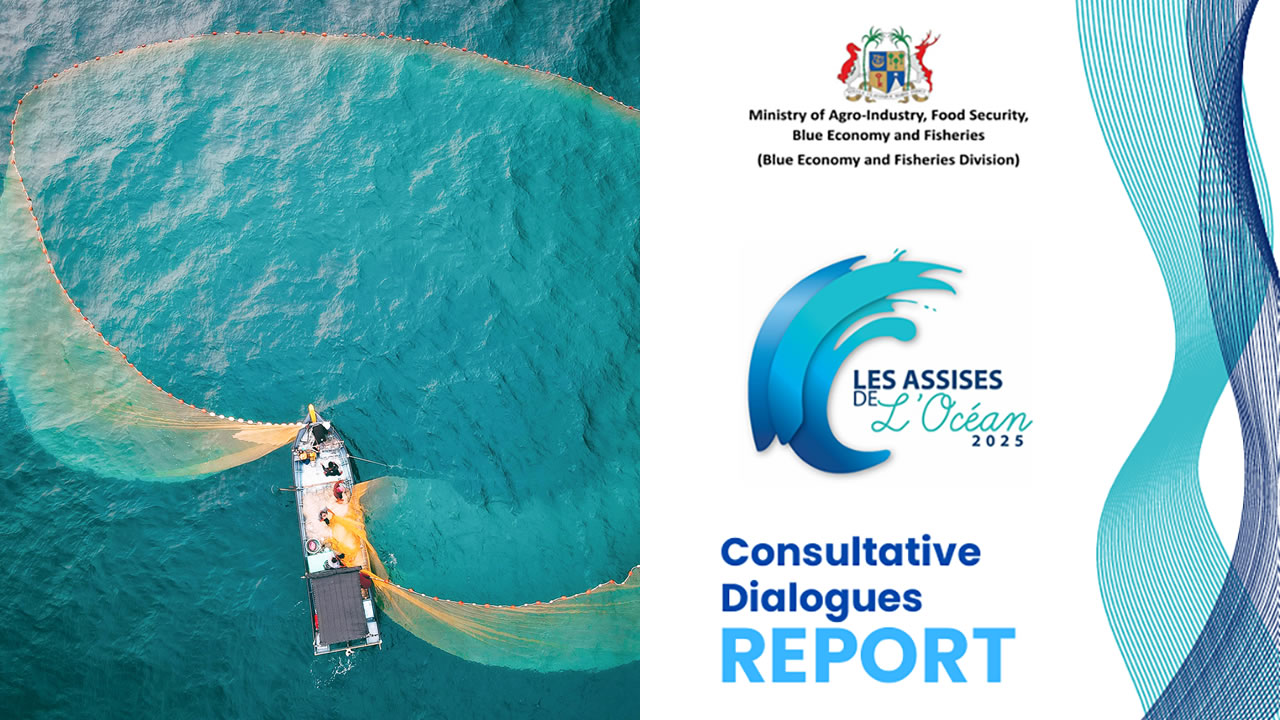
The Indian Ocean, the economic and ecological heart of Mauritius, has been at the heart of a vast national ambition for many years. The pre-consultation dialogues of the “Ocean Conference 2025”, organized by the Ministry of Agro-industry, Food Security, Blue Economy and Fisheries, the final report of which was published this week, provide an uncompromising assessment of the strengths and weaknesses of the Mauritian strategy for the blue economy. Ten themes were scrutinized, from governance to finance, including fishing, tourism and marine energies, revealing a country at the crossroads between climate pressures, governance challenges and opportunities for innovation.
The initial observation is alarming. Marine ecosystems are under pressure “due to climate change, biodiversity loss and unsustainable practices”, summarize the authors of the report. The discussions highlighted the urgent need to act on coral bleaching, coastal erosion and pollution. One participant thus warned of “the need to strengthen conservation measures and integrate climate adaptation into ocean governance”.
However, the main pitfall identified is not only environmental: it is institutional. The discussions highlighted “fragmented governance and agencies working in silos”, as well as “inadequate law enforcement mechanisms”. The case of the scientific research permit is emblematic: the speakers denounce a “long and complex permit system”. To remedy this, the proposal to create a one-stop shop committee is emerging to examine all permits, for all types of research projects, a measure taken up in several round tables.
The education sector is singled out as a major obstacle. As demand for specialist skills grows, the report notes that “only a few schools, including Imperial College, offer the opportunity to take marine science courses for the Cambridge School Certificate”. Worse, this subject was offered for the last time in November 2023, probably due to a lack of sufficient candidates. “Participants highlighted persistent training gaps, limited access to quality education, and the mismatch between programs and labor market needs.”
To remedy this, a central recommendation is to “formulate a national framework for the human capital of the blue economy”, integrating the recognition of prior learning (RPL), micro-certifications and the alignment of technical courses (TVET). “The introduction of compulsory internships” in the courses is also recommended to professionalize young people.
Tourism, a pillar of the Mauritian economy, is set to undergo profound change. If the Tourism Authority presented its initiative to make Mauritius a “green destination
Enjoying Mauritius News in English?
You've used 2 of your 5 free articles today. Subscribe for unlimited access plus a daily newsletter.