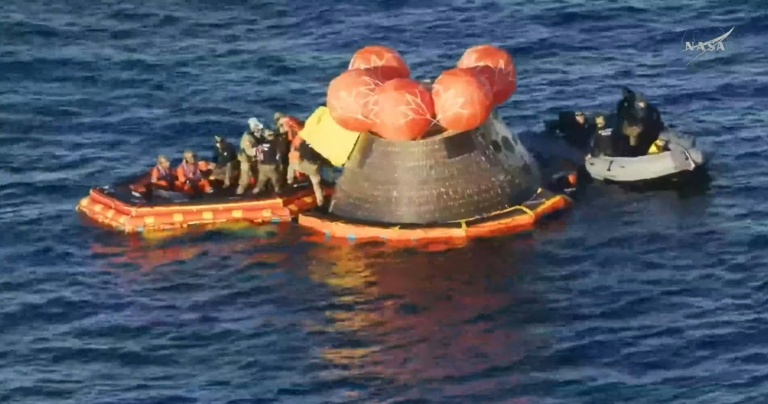
The four American and Canadian astronauts from the Artemis II mission landed Friday evening as planned off the coast of California, crowning a test mission around the Moon perfectly executed by NASA half a century after Apollo.
"What a journey," said Commander Reid Wiseman shortly after the ship landed gently on the water, hastening to add that his comrades were doing well.
Departing on April 1 from Florida, Reid Wiseman and his compatriots Christina Koch and Victor Glover, and the Canadian Jeremy Hansen, ventured further into space than any human before them. They bring back hundreds of gigabytes of data from the first lunar journey since the last Apollo mission in 1972.
Live on several platforms, they passed behind the Moon last Monday, immortalizing in high definition the Earth setting behind a majestic Moon, oscillating between gray and brown hues.
After a descent that took it to exceed 39,000 km/h, their Orion spacecraft managed to land less than 2 km from the planned location, slowed down by huge parachutes, at 5:07 p.m. local time (12:07 a.m. GMT Saturday), to the minute anticipated by the American space agency.
A huge relief for the astronauts' families, this safe return provides NASA with an indisputable success after tens of billions of dollars, years of delays and many doubts about the interest of relaunching lunar exploration.
Senior space agency officials celebrated without reservation, during a late press conference in Houston, the accomplishment of the mission, “the most important we have carried out in decades,” according to Amit Kshatriya, deputy administrator of NASA.
“This is undoubtedly a decisive turning point for all of us,” he exulted.
– “Just the beginning” –
“This is only the beginning,” promised the head of NASA appointed by Donald Trump, Jared Isaacman, aboard the US Navy ship on which the astronauts were brought back, all smiles and still dressed in their orange jumpsuits.
And added: "We will continue to do this frequently, until we land on the Moon in 2028 to build a base there."
“I couldn’t be more proud!†assured US President Donald Trump on his Truth Social network, while Canadian Prime Minister Mark Carney hailed the achievement of a “historic feat†on X.
Orion's heat shield, which gave NASA a cold sweat after pieces broke off during an empty test in 2022, apparently withstood the 2,700°C generated during the re-entry test atmospheric.
– Objective 2028 –
So many concerns swept away by this controlled landing, which concludes approximately ten days of a “perfect mission” in the words of the boss of the
Enjoying Mauritius News in English?
You've used 3 of your 5 free articles today. Subscribe for unlimited access plus a daily newsletter.