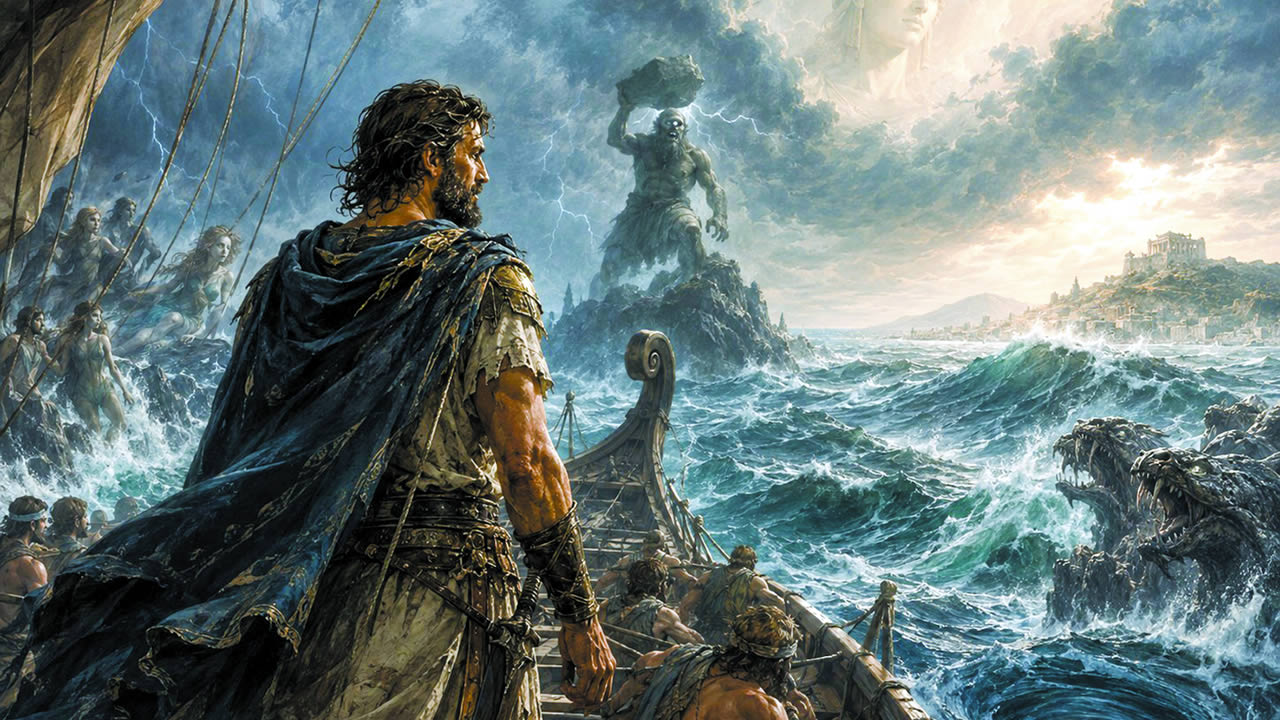
On the occasion of the release of Christopher Nolan's new blockbuster, immerse yourself in the epic tale of Ulysses, his monsters, his gods and his trials.
Written nearly three millennia ago by the Greek poet Homer, “The Odyssey” recounts the most famous journey home in world literature: that of Odysseus, king of Ithaca, who attempts to return to his kingdom after the Trojan War. But his return, which should have lasted a few days, turns into a ten-year wandering. Between the wrath of the gods, fantastic creatures and the traps set by destiny, Ulysses goes through a succession of ordeals that have shaped the collective imagination for centuries.
Divided into 24 cantos, the poem constitutes the second major text attributed to Homer after “The Iliad”, dedicated to the Trojan War. Where the first story recounts the fury of the fighting, “The Odyssey” focuses on the post-war period: how a man returns home after having lost part of his life. Here are the keys to understanding this monumental work.
In the collective imagination, Achilles often remains associated with the Trojan War: the invincible warrior, symbol of strength and courage. However, the one who allows the Greeks to achieve victory is not the most powerful fighter, but the most intelligent. Ulysses is the one who imagines the famous wooden horse with which the Greeks enter the enemy city. His main weapon is not strength, but cunning.
This is precisely what makes the character so ambiguous. Ulysses is courageous, brilliant and capable of the greatest exploits, but he is also proud, manipulative and sometimes responsible for his own misfortunes. His intelligence allows him to survive dangers, but his pride also triggers some of the most dramatic events of his journey. Adapting such a complex character was, in fact, one of the great challenges for Christopher Nolan. He recently explained to Time magazine that the difficulty was to preserve the contradictions of Ulysses while making him a hero to whom the public could attach.
Contrary to what one might imagine, “The Odyssey” does not tell the story of Ulysses’ journey in chronological order. The story begins when ten years have already passed since the fall of Troy. Odysseus is still absent, held prisoner on the island of Ogygia by the nymph Calypso, while his kingdom of Ithaca descends into chaos.
His wife Penelope refuses to believe in his death and tries to repel the many suitors who want to marry her to seize the throne. Their son Telemachus, now an adult, goes looking for him.
Thanks to the intervention of the goddess Athena, the gods end up ordering the release of Odysseus. But barely does he return to sea when Poseidon, god of the oceans and sworn enemy of the hero, causes a new storm. After a shipwreck, Ulysses ends up among the Phaeacians.
This is where the story shifts: invited to tell his story
Enjoying Mauritius News in English?
You've used 1 of your 5 free articles today. Subscribe for unlimited access plus a daily newsletter.

![[Evening Info]: “Veronique oci pou interoze”](/media/article_images/3f0ff8612f00.jpg)