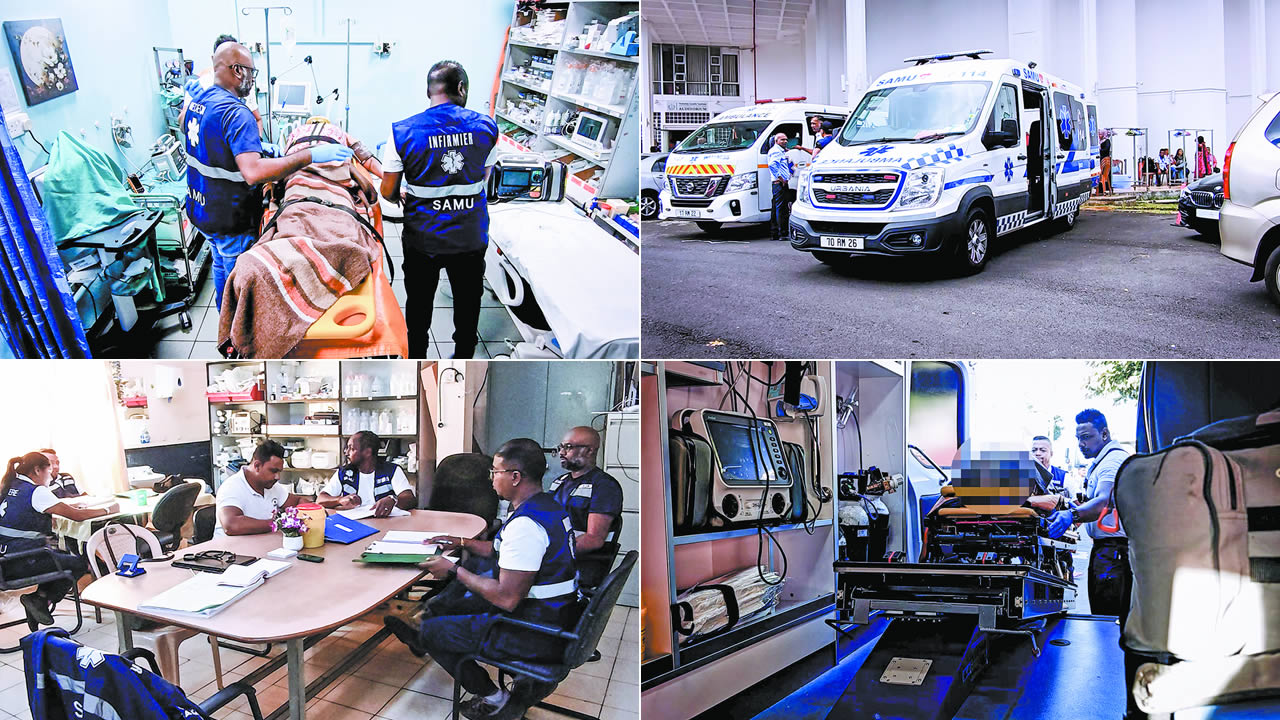
They are regularly overwhelmed by salvos of criticism and are attacked by an impatient public. However, behind the incompressible deadlines and the drastic prioritization of absolute emergencies, lies a completely different reality. Exclusive immersion of TéléPlus within this intervention unit.
Since 1998, Samu has provided treatment for medical emergencies across the country. Its teams intervene in situations where each decision must be made quickly and precisely. A service where each intervention is based on precise organization, established protocols and medical procedures adapted to the needs of patients.
The heart of this emergency mechanism is found in the 114 control room, operational 24 hours a day. On each shift, six permanent workers are on the front line to respond to the distress of an entire island. Their crucial mission is to obtain vital information in a few seconds, reassure the panicked interlocutor and clinically assess the emergency. More than 2,000 calls on average converge on 114 every day.
Above them, a man supervises everything: a regulating emergency doctor, ready to trigger emergency services at the slightest alarm signal. Emergency physician Vinesh Teeluck emphasizes the critical role of this step: “Regulation is the essential filter of the system. Receiving 2,000 calls per day means knowing how to discern, in a matter of seconds, vital distress from simple discomfort. » The role of the Samu is not only to dispatch vehicles, but to project the hospital beyond its walls, where life hangs by a thread.
“The Mauritian Samu operates on the French SMUR model, based on direct medicalization at the scene of the incident. Strict clinical and logistical rules govern each departure. Today, 11 teams are spread across the island. The objective is to carefully survey the territory to intervene as quickly as possible,” explains emergency doctor Yogeeta Jugnah-Boodhoo.
Around 10:00 a.m., a first alert sounded. Direction: Curepipe metro station. A 60-year-old man has just collapsed suddenly on the platform. The sirens wail and the medical vehicle rushes through the traffic. Less than ten minutes later, the team was already there. The patient is urgently stabilized, infused, then evacuated to Victoria Hospital where he will be admitted to the ward. This procedure will take 2 hours.
In the middle of the day, the phone rings again. This time, it was in the auditorium of the Mahatma Gandhi Institute (MGI) that a woman felt unwell. On site, gestures are precise, almost automatic. The patient is taken care of and medically safe, but to elucidate the neurological or cardiac origin of her condition, a CT scan is essential.
The crew immediately headed to the hospital emergency room. It’s a quick mission, carried out without the least
Enjoying Mauritius News in English?
You've used 1 of your 5 free articles today. Subscribe for unlimited access plus a daily newsletter.
![[Evening Info]: “Veronique oci pou interoze”](/media/article_images/3f0ff8612f00.jpg)