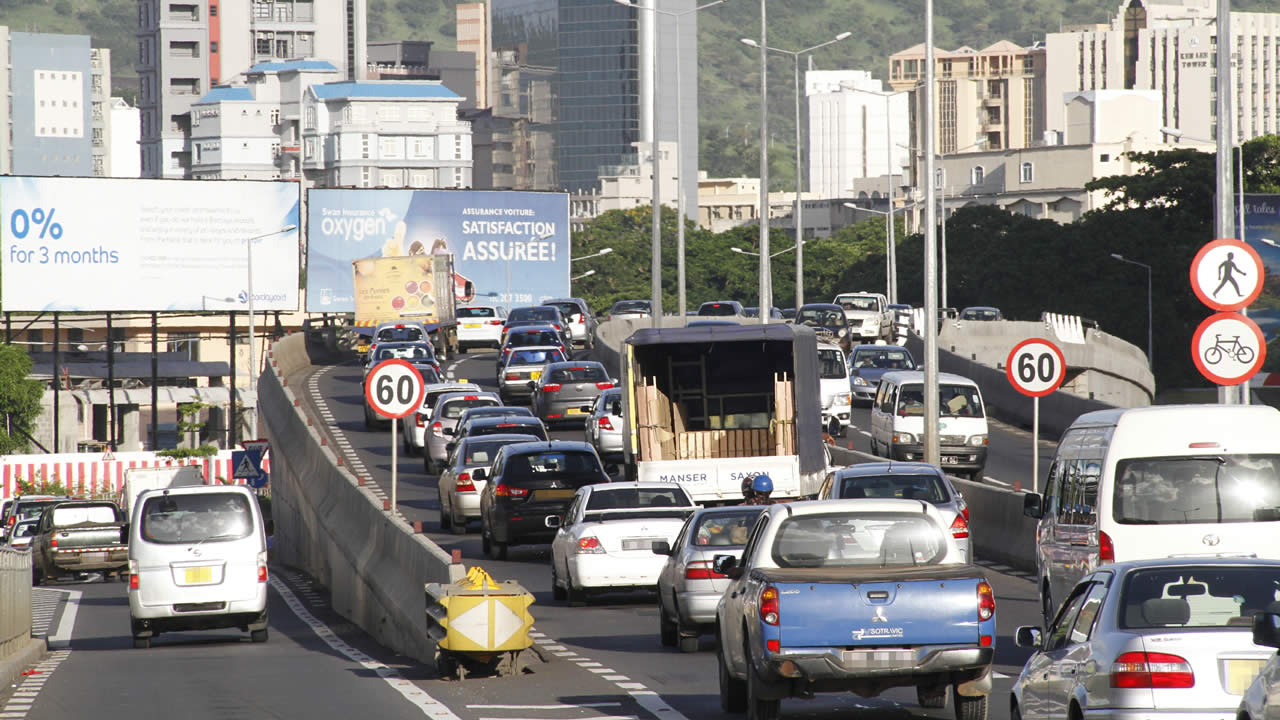
Faced with the explosion in the automobile fleet and now widespread congestion, the government's responses are hotly contested by experts. Everyone agrees on one thing: time is running out.
The figures from the National Land Transport Authority (NLTA) are hardly open to discussion. Between January and April 2026, 10,404 new vehicles were registered in Mauritius, or 86 more every day on a network that serves an island of 1,865 square kilometers. The total vehicle fleet numbers more than 756,000 units for 1.3 million inhabitants, or nearly 580 vehicles per 1,000 inhabitants. When compared to areas that can actually be traveled only – once mountain ranges, forests and agricultural land are subtracted – the ratio is even higher.
The effects are visible on a daily basis. For a long time, traffic jams mainly affected large urban centers, as well as the main access points to Port-Louis. Now, congestion affects virtually every region of the country. During peak hours, several routes experience significant slowdowns: the M1, access to Ébène, Terre-Rouge, Quatre-Bornes, but also certain regions in the North.
In several cities, the lack of parking spaces has become a daily problem for motorists, businesses and local residents. The wear and tear of road infrastructure is accelerating with the constant increase in traffic.
Added to this are economic consequences that several observers now consider as worrying as the discomfort of users: massive imports of cars, fuel consumption and pressure on currencies are weighing on the national economy in a context of depreciation of the rupee. Unlike some countries facing high road congestion, Mauritius currently has neither an urban toll nor a strict quota on vehicle imports. In fact, consumers can still purchase new or used vehicles without major limitations, thus fueling continued growth in the vehicle fleet.
Faced with these findings, the Minister of Transport, Osman Mahomed, defends the action taken, while recognizing the scale of the challenge. “Among the many problems related to road safety in Mauritius, we have traffic jams, road accidents, pollution, road rage and above all the economic impact of the importation of vehicles,” he lists.
His ministry is currently working on the Land Transport Master Plan, a strategic document developed in collaboration with the United Nations, the horizon of which is set at around twenty years. “The Land Transport Master Plan will address the transport problem in Mauritius through new policies,” he explains.
On the 2025 measures, the minister wants to be reassuring: “I must add that in 2025, we applied measures to control the number of vehicles on our roads. Happy
Enjoying Mauritius News in English?
You've used 1 of your 5 free articles today. Subscribe for unlimited access plus a daily newsletter.